
Opinion / Getting good at AI
Prompting isn't the skill. Process design is.
Recent research from Bain and Stanford points the same way: AI pays off when a company redesigns the work around it. I think too much AI training stops at prompting. Before the next course, write down how one job really gets done.
On 18 November 2026, Bain published research on how companies use AI. One chart in it shows why some companies get results and others don't.
Bain's AI readiness surveys ask about 200 companies at a time, and it has run them since late 2023. It sorted companies by how much they changed the work around AI. Only 8% simply added the tool. A quarter rebuilt the workflow from scratch. Of the companies that rebuilt it, 48% said AI beat their goals. Among the rest, about 23% did. Bain says the only way to get value is "intensive workflow redesign".
My view is that too much AI training stops at prompting. The skill that pays is process design. That means knowing how a piece of work really gets done, and deciding which parts a machine should do.
Why prompting got all the attention
When chat tools arrived, the prompt was the part everyone could see. A prompt is the instruction you type into the tool. Good prompts get better answers, and you can teach the basics in an afternoon. So, as I see it, that is where most AI training started.
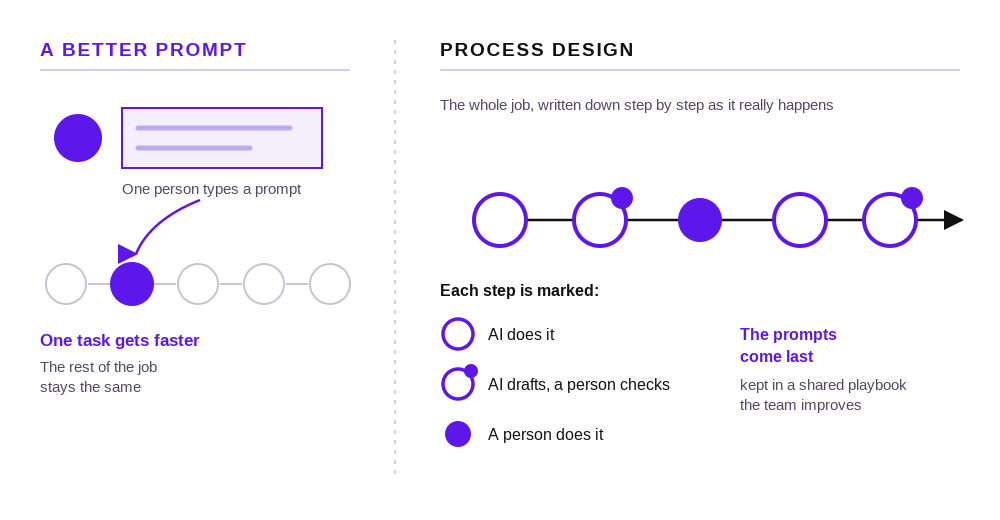
A better prompt helps one person do one task faster. That is useful, and it is a sensible first step with AI. It rarely changes what the business delivers. The order still waits for the same approval. The customer still gets the same reply time. The report still needs the same three people to agree on the numbers.
The gains Bain describes come from changing the job itself. That means deciding who does each step, in what order, with what information, and who checks the result.
A prompt speeds up a task. A redesign changes the job.
What process design means in practice
Process design is what a good operations manager already does.
You take one job, such as answering a supplier query or onboarding a new customer. You write down every step as it really happens today. That includes the spreadsheet someone updates on Fridays and the chat group where exceptions get settled. You note what each step needs to know, where someone makes a judgement call, and what a finished job looks like.
Then you decide, step by step, who should do it. Some steps the AI can do on its own. Some it can draft for a person to check. Some stay with a person. The prompts come last, and they are easy to write once you know the job this well. They also belong to the team, kept in a shared playbook, so the next person starts from the best version.
Successful teams mapped the work first
Stanford's Digital Economy Lab studied 51 successful AI projects at 41 organisations, and published its playbook in April 2026. When the researchers asked what was hardest to fix, 77% of the answers were change management, data quality and process redesign. Change management means getting people to work a new way. The technology, the researchers wrote, was "consistently described as the easiest part". One telecom executive put it plainly: "All the hard work is in process documentation and data architecture". Data architecture means how a company's information is stored and connected.
The report also found that 61% of these successful projects followed at least one failed attempt. Stanford found the failures shared a pattern. Teams treated AI as a technology project. Many applied it to broken workflows.
One case shows the difference. A mid-sized translation services company tried AI for recruiting and failed. Among other things, it assumed the AI would fix a broken process. On the second attempt the chief executive took ownership, and the team mapped the whole recruiting workflow first. Stanford reports the new system took about a month to build. The time to screen candidates for each role fell from three hours to three minutes.
Where process design goes wrong
Mapping can go wrong in three ways.
The first is mapping the process as the manual says it works. The real process lives with the people who do it every day. If you leave them out, the AI copies a process nobody follows. The Adecco Group's study of 40,500 workers in 36 countries, published on 19 November 2026, points the same way. Of workers involved in redesigning their own work, 96% said they were willing to adapt. Of those left out, 29% said so.
The second is automating a broken step. Stanford warns that "AI amplifies whatever process it is applied to". If a step exists only to work around a bad system, fix or remove it first.
The third is mapping forever. A process map is a working tool for one job. Map one workflow, change it, measure it, then move on to the next.
What the research says
- of companies that rebuilt the workflow said AI beat their goals (Bain)
- 48%
- of the other companies said the same (Bain)
- about 23%
- of the hardest problems were change, data and process redesign (Stanford, 51 successful projects)
- 77%
- of workers involved in redesigning their work were willing to adapt, against 29% of those left out (Adecco)
- 96%
What to do this month
Start with one workflow and one owner. This is what I would ask a team to do.
- Pick one job that hurts, and name the person who owns the result.
- Sit with the people who do it, and write down every step as it really happens.
- Mark who should do each step, using the three marks above.
- Agree what a good result looks like, and measure it before and after.
- Then write the prompts, and keep them in a shared playbook the team improves.
Learn prompting, but redesign one workflow
I build AI systems for a living, so I have an interest in companies taking this seriously. You don't need to buy from anyone to do the work above.
Prompting is still worth learning, and it takes an afternoon. Knowing your own work well enough to redesign it takes longer, and nobody outside your business can do it for you. Before the next prompting course, ask which workflow you are redesigning, and who owns it.
Sources
- Bain & Company — Survey: Workflow redesign is key to AI success; published 18 November 2026; accessed 24 November 2026 ↗
- Stanford Digital Economy Lab — The Enterprise AI Playbook: Lessons from 51 successful deployments (Pereira, Graylin and Brynjolfsson); published April 2026; accessed 24 November 2026 ↗
- The Adecco Group — Global study: AI delivers more value when people are involved in work redesign (press release); published 19 November 2026; accessed 24 November 2026 ↗